

The standard slide says automation removes the human from the dangerous work. The standard objection says automation removes the human from the job. Both are describing the same imagined future, and both are wrong about the same thing.
Start with how a plant is actually orchestrated today, because it is rarely written down anywhere.
The scheduling system says which orders run. The maintenance system says which assets are due. Neither of them knows who can run line three alone at 3am. That knowledge is in the head of the shift supervisor, who holds an undocumented map of which of his people can do what, who is quick, who needs watching on the changeover, who has never actually done the isolation without help. He allocates work against that map every shift, correctly, and the map leaves the building when he does.
That map is the orchestration layer of the human side of your plant. It is a person’s memory. It is not backed up.

What the next five years actually do
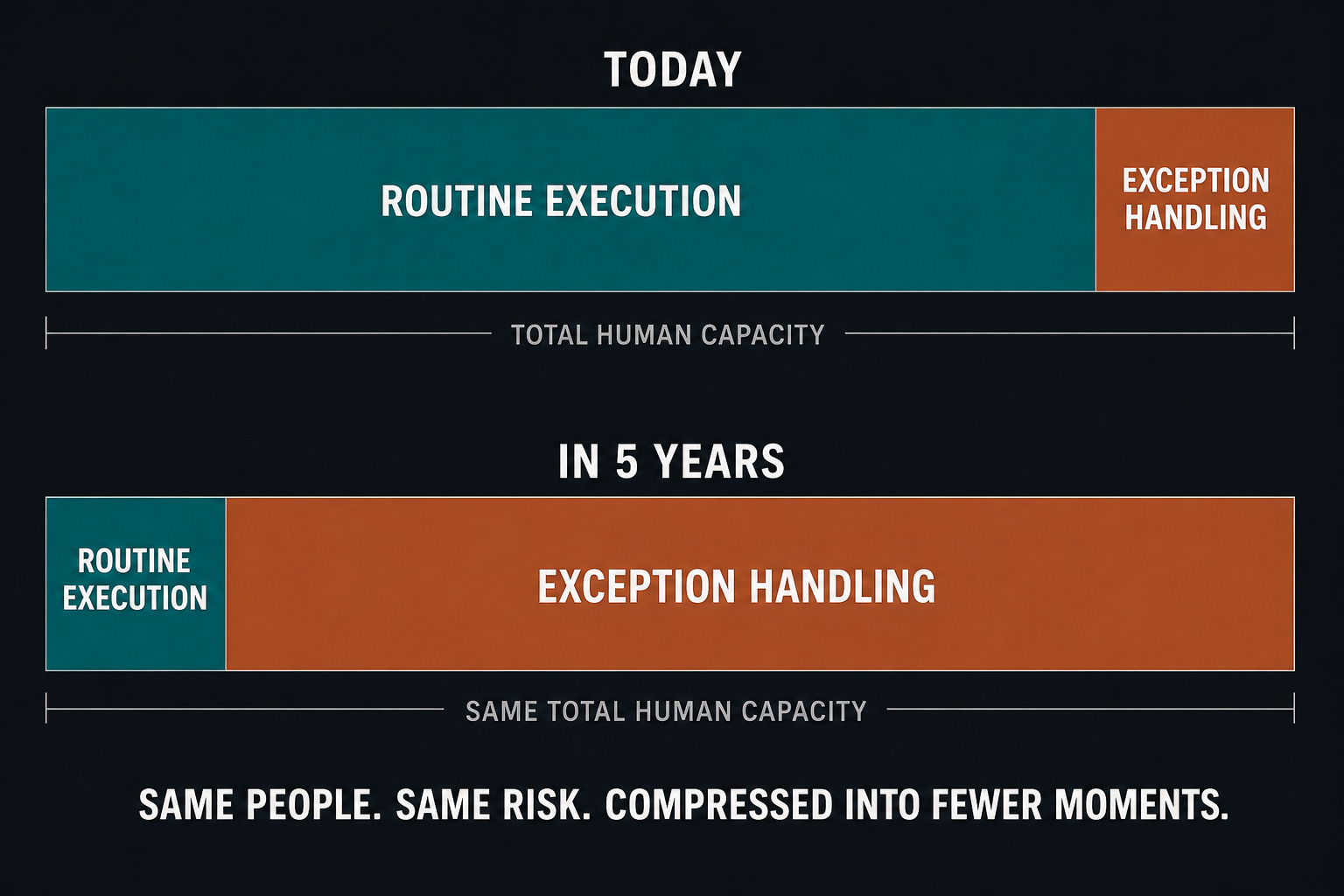
Robots and physical AI are going to absorb routine execution, unevenly and slower than the conference talks suggest, but genuinely. Follow what that leaves behind.
The human portfolio does not shrink proportionally. It concentrates into exception handling: the abnormal state, the thing the design did not anticipate, the weak signal at 4am. In human-factors terms, that is knowledge-based cognition, which is the slowest and highest-error-rate mode people have. So the work that remains is the work humans are worst at, performed on higher-consequence equipment, by fewer people, with fewer peers nearby to catch a mistake.
Then the second-order effect, which is the one nobody plans for. Veterans are made by years of routine work. If juniors never do the routine work because a machine does it, the ladder that produces future experts is gone. You do not notice for a decade, and then you cannot hire your way out of it because the people you need were never manufactured.
Aviation ran this experiment already. Autopilot removed routine flying, and pilot skill decay plus startle response became the central safety problem of the industry. Not because the automation was bad. Because the automation was good, and the human role changed underneath it while everyone was still measuring the old thing.
The conclusion is uncomfortable and, I think, correct: the per-capita human-factors problem gets worse under automation, not better. Fewer people, each in the most error-prone cognitive mode, at higher stakes.
What orchestrating the human layer means
Not monitoring people. Three specific capabilities, all of which are currently either absent or living in one person’s memory.
Knowing the state, not the record. Not who holds a certificate, but who is currently able to perform this procedure on this machine, and when that is likely to have faded. Readiness is a state and it decays. A certificate is a photograph of a state on one date.
Routing work against the state. If the system knows that only two people on shift can perform the changeover unsupervised and one of them is on leave next week, that is a production decision, available before the week starts rather than after the line stops. This is the version of the human layer that a plant manager can actually use, because it is denominated in his units.
Capturing the second procedure. Every plant runs two versions of every procedure: the one in the binder, and the one that actually runs. The gap is where the improvisation lives, and the improvisation is mostly what keeps the plant running. Today that gap is invisible and it dies with the people who hold it. The only channel that can capture it is a channel the worker is already talking to, in the moment, for their own reasons.
None of this replaces a worker. It makes the worker’s judgement legible to the organisation, which is the opposite of replacing it. Right now that judgement is the most valuable and least documented asset in the building, and the standard plan for preserving it is hoping the person stays.
The five-year picture, stated plainly
In the morning production meeting, next to OEE and downtime and yesterday’s output, there is a number for readiness: by line, by shift, by machine. It moves. When it drops, somebody knows before the audit or the incident tells them. That is not a transformation programme. It is one number that does not exist today, and the reason it does not exist is that nobody has been measuring the human layer as a live state instead of a filing requirement.
