

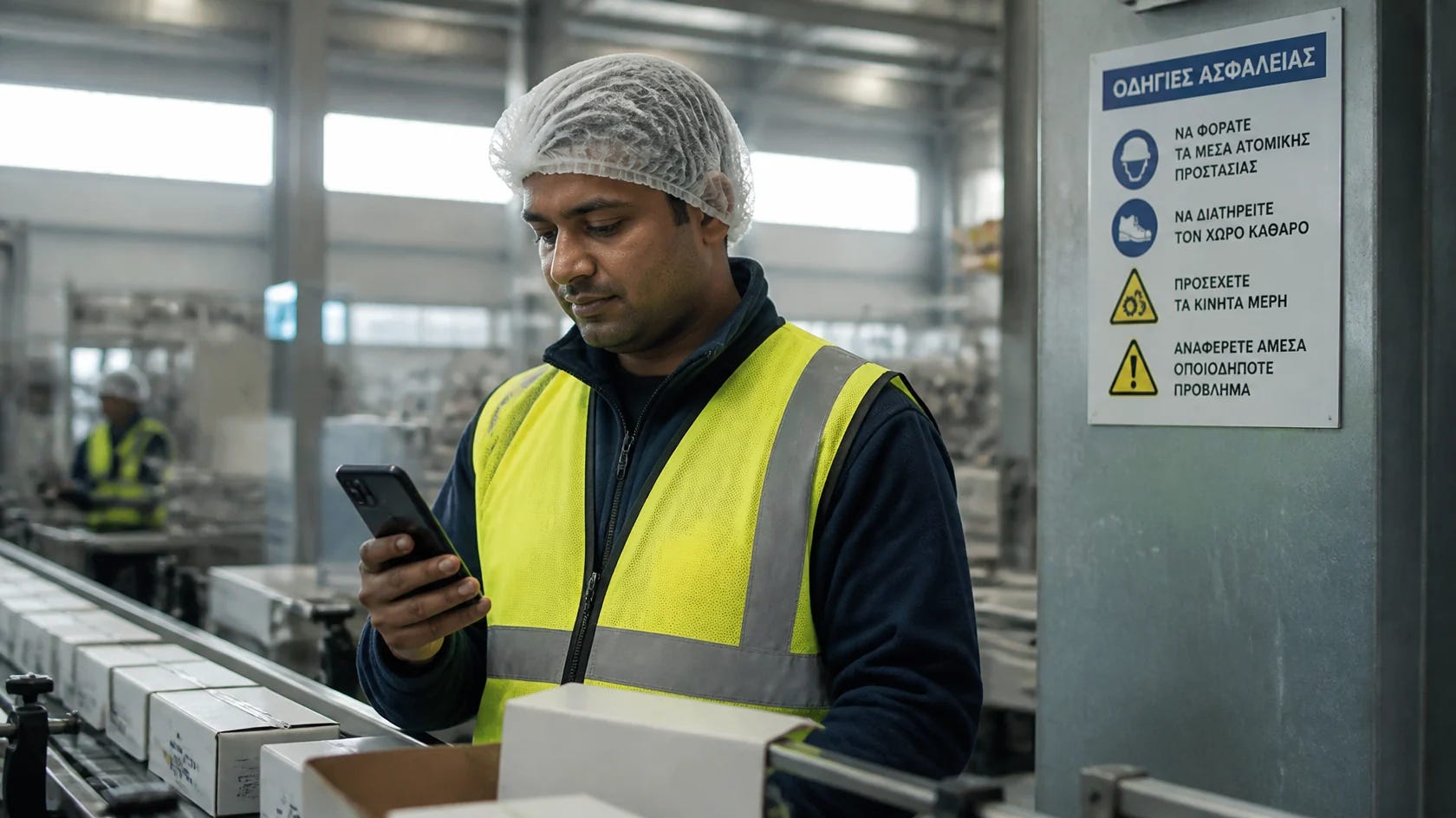
In a lot of factories and construction sites in Cyprus, the safety briefing is delivered in a language a large part of the crew cannot read. The safety officer presents in Greek, the attendance sheet is signed, the file is closed. The worker from Nepal or Egypt who will stand next to the machine on the next shift has understood whatever a colleague managed to explain during the break.
This is not a hypothetical. It is daily life in every plant that has brought in third-country staff in the last three years. And it is a gap that compliance audits never see, because the paperwork is in order.
This piece shows how big the gap is in numbers, why a signed form does not protect you, and what an operations manager can do in the next quarter without turning the safety department upside down.
Who is actually working the line
According to Deputy Ministry of Migration figures published by the Cyprus Mail on 27 September 2026, there were 26,710 valid residence and work permits in the general employment category at the end of August 2026. Nepalese nationals make up 28.8 percent of those workers and Indians 21.9 percent, followed by Egyptians, Bangladeshis, Sri Lankans and Filipinos. The sectors where they are allowed to work are exactly the sectors with machinery: manufacturing, agriculture, livestock, delivery, wholesale and retail.1
That is tens of thousands of people whose first language is Nepali, Hindi, Arabic, Bengali, Sinhala or Tagalog. Some manage in English. In Greek, almost nobody does in their first year.
Safety communication in Cyprus, however, was designed for a Greek-speaking workforce. The SOPs are in Greek. The signage on the machines is in Greek or in the manufacturer’s language. The toolbox talk is given by the foreman in Greek, with an unofficial interpreter from the crew who has never been trained on the subject himself.
Accidents are falling, except in the sectors that depend on foreign labour
The national numbers look good. The Department of Labour Inspection announced on 29 July 2026 that the accident rate fell 7.2 percent in 2025 compared with 2024 and 55.3 percent since 2017. The big reductions came from retail, transport and hotels.2
The two sectors that went the other way are manufacturing, up 11.7 percent, and construction, up 3.9 percent. They are the same sectors that lean most heavily on third-country staff. I am not claiming language is the only cause. Falls remain the leading cause, at 31.4 percent of all accidents across sectors. My point is simpler. When your sector’s accidents are rising while the country’s are falling, you have to look at what changed in your sector. And what changed is who is standing in front of the machine.
What the research says, and what the law says
The International Labour Organization has identified language barriers as one of the factors that undermine the safety of migrant workers and recommends safety training in the worker’s mother tongue. That is set out in Policy Brief 2019/4 of the European Centre for Social Welfare Policy and Research, which studied the issue across nine EU countries. The same brief summarises the literature: language barriers are linked to difficulty understanding safety instructions and to the inability to pass on a warning about a dangerous situation in time. In practice, workers fall back on colleagues who translate and on translation apps on their phones.3
The law leaves little room for interpretation. Article 12 of Framework Directive 89/391/EEC, the foundation of Cyprus’s safety and health at work legislation, requires the employer to ensure that every worker receives adequate training, in the form of information and instructions specific to the job, on recruitment, on any change of role and on any new equipment or technology. Article 6 requires appropriate instructions to workers and restricts access to areas of serious danger to those who have received them.4
Training the worker did not understand is not adequate. The inspector who arrives after the accident will not ask the safety officer what he presented. He will ask the injured worker what he understood.
Why the signed form does not protect you
Certification proves the training happened. It does not prove it was understood. In a Greek-speaking crew the distance between the two is small, and experience covers it. In a multilingual crew that distance is the entire process.
I learned this before I became a founder. For years I trained technicians who climbed telecom towers. In the classroom they laughed, looked at their phones, signed the attendance sheet. One day I put the slides away and described what each man’s family would hear on the phone if he fell. The room changed within a minute. The instructions were the same as before. What changed was that they landed. If that is true for people who speak your language, think about what is true for people who do not.
The instructions were the same as before. What changed was that they landed.
This year, in a conversation with a large food manufacturer in Cyprus with roughly 500 people in production and warehousing, the first practical obstacle to digitising mandatory hygiene and safety training was not budget and was not the system. It was that the material had to exist in Greek, English, Hindi and Arabic, and that most of the workforce has no company email. Those two sentences describe half of Cypriot industry.
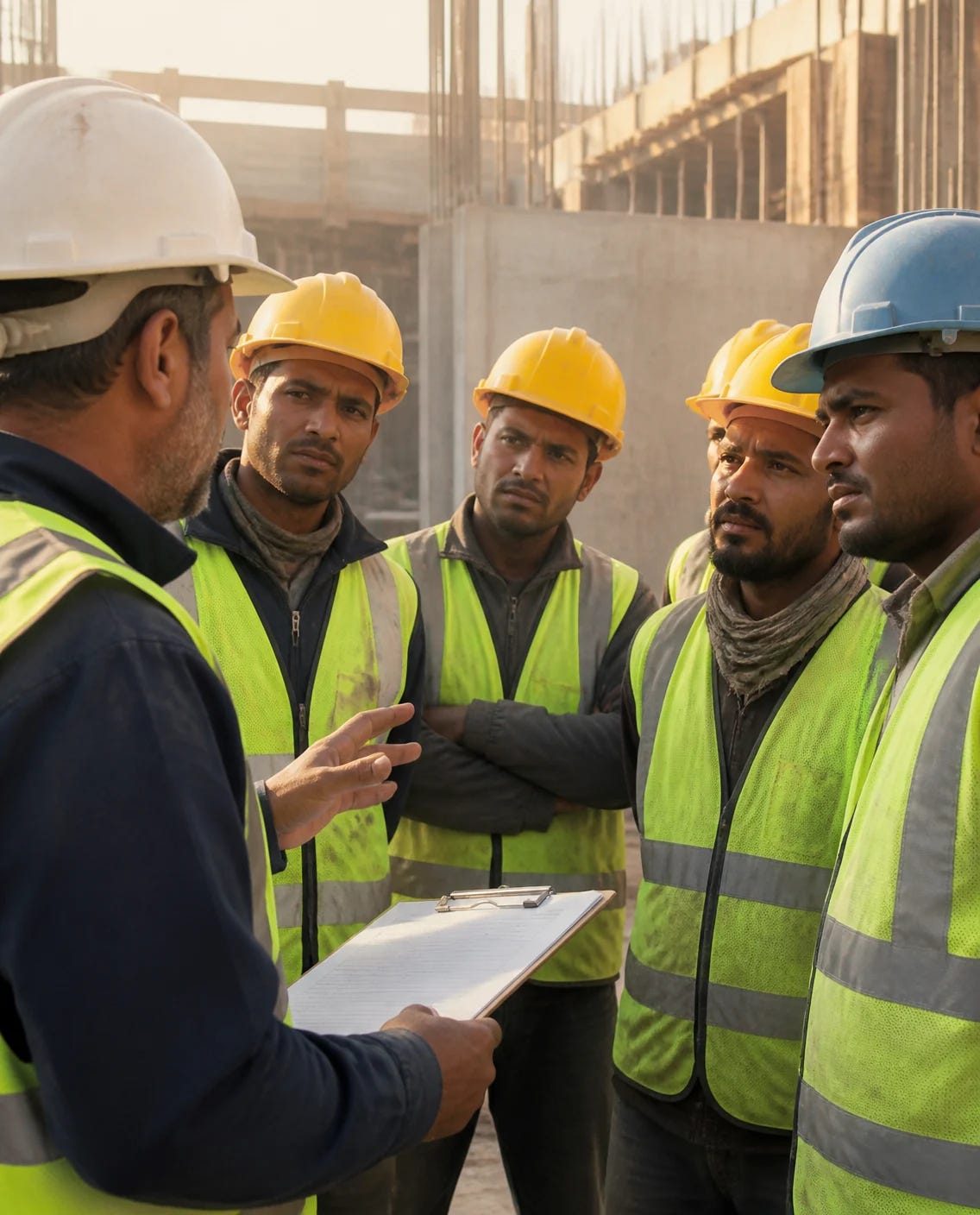
What translated safety communication actually means
It means three things, and most plants do at most one of them.
The content in the worker’s language, not an auto-translated PDF of the Greek procedure that nobody checked.
The channel the worker already uses. His phone, WhatsApp or Viber. Not the noticeboard, and not the email he does not have.
Proof of understanding, not proof of attendance. Three questions in his language, logged per person and per task.
At Senera this is exactly what we work on. From the same SOP we generate the training in each worker’s language in minutes, and with Sen Comms the shift briefing, a procedure change or an urgent warning reaches his phone, in his language, with confirmation that he read it and understood it. The operations manager sees who is ready for which task today, not who signed last year.
What to do this quarter
Measure the gap. Which languages does your workforce speak, by shift and by role? If you do not know precisely, that is finding number one.
Take the five most dangerous tasks in the plant and check which language their instructions exist in, and who has actually read them.
Change the evidence. From “signed that he was briefed” to “answered correctly in his own language”. It is a small change in procedure and a large change in what you know.
Stop relying on the colleague who translates. For the weekly roster, fine. For the lockout on the machine, no.
The next inspection will not ask whether you ran the briefing. It will ask the worker what he understood. Better to know the answer before the inspector does.
If this is the kind of floor you run, the next pieces are for you.
Cyprus Mail, Cyprus labour shortages: who can legally work?, 27 September 2026. https://cyprus-mail.com/2026/09/27/cyprus-labour-shortages-who-can-legally-work
Cyprus Mail, Fewer labour accidents in 2025, Department of Labour Inspection announcement, 29 July 2026. https://cyprus-mail.com/2026/07/29/fewer-labour-accidents-in-2025
Zólyomi E. and Danaj S., Language barriers and the occupational safety and health of posted workers, European Centre for Social Welfare Policy and Research, Policy Brief 2019/4. https://www.euro.centre.org/downloads/detail/3473/1
Council Directive 89/391/EEC of 12 June 1989, Articles 6 and 12. https://eur-lex.europa.eu/eli/dir/1989/391/oj/eng